
Teardowns, gut-outs and site clearing inside the city limits
Demolition Contractors in Atlanta, GA
Whole-house demolition, interior strip-outs, slab and driveway removal, pool fill-ins and outbuilding teardowns, permitted the way the City of Atlanta requires.
- Free walk-through and a written, itemized estimate
- Permit, utility and tree steps mapped out before any machine arrives
- Debris sorted, hauled and the lot left rough-graded
Demolition Work Built Around Atlanta's Permit Process
Atlanta is our home market, and demolition contractors working inside the city limits spend as much time on paperwork as on the excavator. The city counted 498,715 residents in the 2020 census, spread across 242 officially defined neighborhoods in Fulton and DeKalb counties. On any given week we might be clearing a 1920s bungalow for a new house in a streetcar suburb, gutting a kitchen and two baths down to studs, breaking out a cracked driveway, or filling in a backyard pool that nobody swims in anymore. Each of those jobs touches a different set of city offices, and we plan around them before anything is torn down.
What the city asks for before a teardown
The Atlanta Municipal Code makes it unlawful to demolish a structure without first getting a building permit. The city's demolition procedures list several items that surprise owners who have never done this before:
- A rodent letter. A current letter on an exterminator's letterhead showing the property has been treated, so rats leave with the building instead of moving next door.
- A plumbing permit for a sewer plug. The old sewer lateral has to be plugged so groundwater and debris do not get into the city's system.
- Site plans with erosion control. Twelve copies, routed to Site Development, the Arborist, Zoning, Plan Review and the Office of Planning. The three arborist copies must show trees, buildings, roads and driveways.
- Asbestos notification. If the job involves asbestos removal or encapsulation, the permit is not issued until a notification from the Georgia EPD Asbestos Licensing and Certification Unit is presented.
Utility disconnects for power, gas and water are arranged with each provider before the structure comes down. We build the schedule around those steps so the crew is not sitting idle waiting for a letter.
Trees are part of every Atlanta demolition
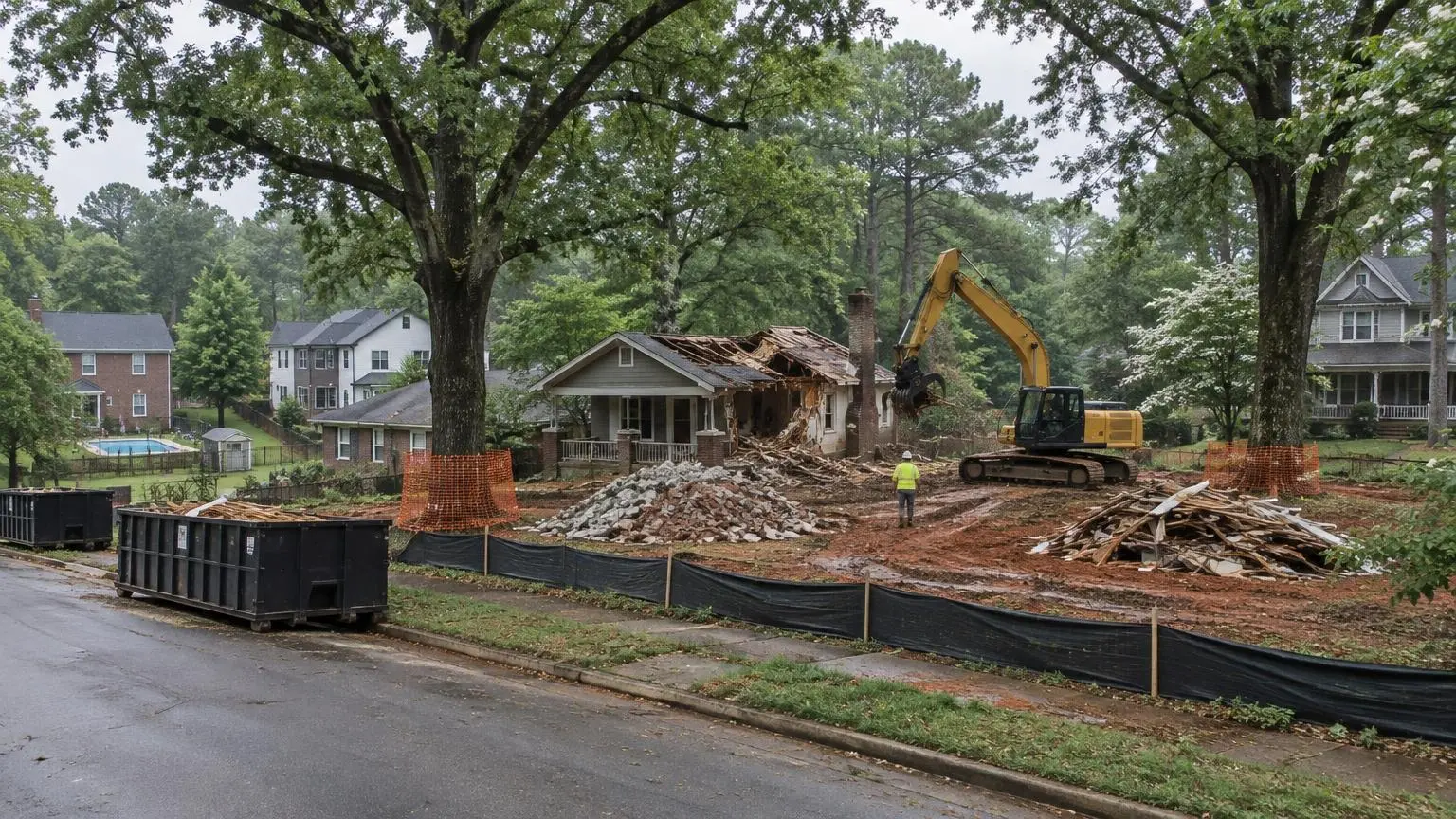
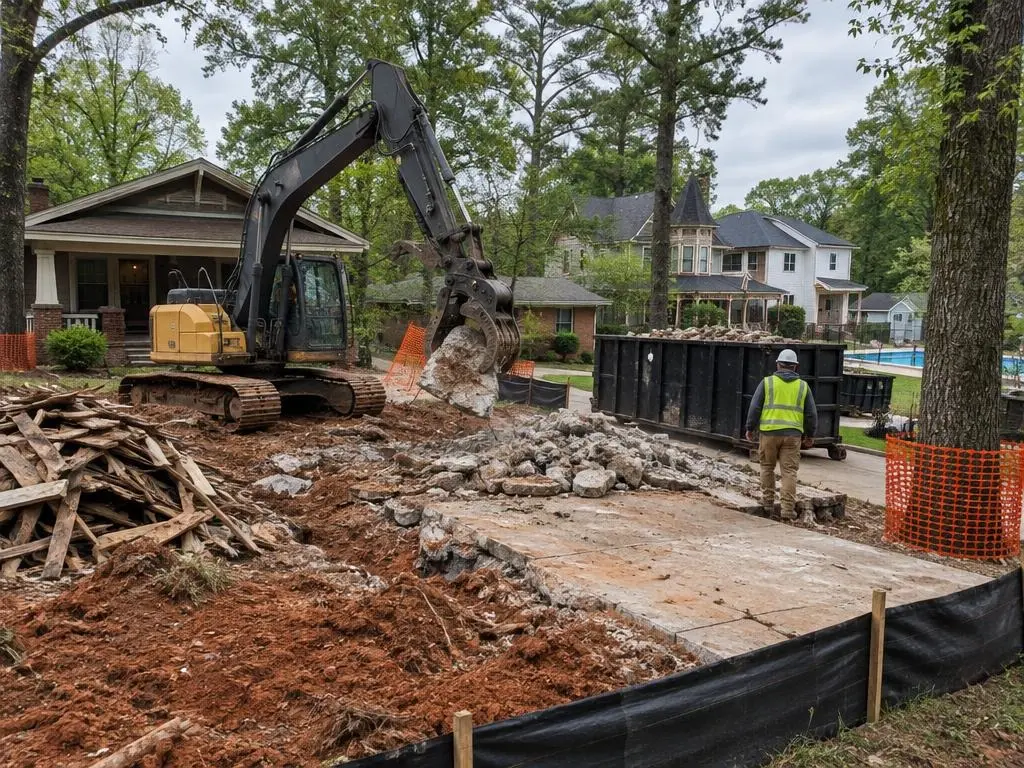
Atlanta has the densest urban tree coverage of any major U.S. city, and its Tree Protection Ordinance shapes how we stage a job. Under the Arborist Division's rules, removing a tree with a trunk diameter of 6 inches or more at breast height takes a permit, or 12 inches for pines. Trees affected by construction are handled under the building permit and reviewed by the Arborist Division, and healthy trees taken down for construction carry a recompense charge. Violations are a criminal offense with a minimum first-offense fine of $500. In practice that means we plan the equipment path, the dumpster spot and the haul route so root zones of the trees you are keeping stay protected.
Historic districts and landmark buildings
Atlanta has lost plenty of landmarks to the wrecking ball. Terminal Station came down in 1972 and the Carnegie Library in 1977, and the Fox Theatre was nearly razed in the mid-1970s before a grassroots campaign saved it. Today, demolishing a building in a designated historic or landmark district goes through the Atlanta Urban Design Commission and a Type IV Certificate of Appropriateness. The city's application packet sets out two routes: showing a major and imminent threat to public safety, or showing the property cannot earn a reasonable economic return. Both require detailed evidence. If your lot is in Inman Park, West End, Whittier Mill or another protected area, we will tell you up front whether a teardown is realistic or whether interior demolition and a renovation make more sense.
The houses we take down most often
Wikipedia notes that the craftsman bungalow is the dominant single-family house type in Atlanta's lower-density neighborhoods, and the eastside streetcar suburbs were built from the 1890s to the 1930s. Older houses like these tend to sit on brick piers or low crawlspace foundations, with plaster walls, heart pine framing and sometimes old ductwork wrapped in insulation that needs testing. Postwar areas such as Collier Heights and Cascade Heights have ranch houses on slabs or block foundations, which come apart differently. We look at the foundation, the access from the street and the distance to the neighbors' houses before we pick the machine.
Weather and ground conditions
The city sits at about 1,050 feet, the highest elevation of any major city east of the Mississippi, and gets around 50.43 inches of precipitation a year. Rain turns a cleared lot into mud quickly, so silt fence and a gravel construction exit go in before the house comes down. Storm damage also brings demolition calls: an EF2 tornado tore through downtown on March 14, 2008. Call (470) 260-8440 and tell us the address, what is coming down and what you plan to build next.
Atlanta Facts That Shape a Demolition Job
- Sewer plug and rodent letter. The city's demolition procedures require a rodent letter and a plumbing permit for a sewer plug before a demolition permit is issued.
- Tree permits. Removing a tree 6 inches or more in diameter at breast height (12 inches for pines) requires a permit under the Tree Protection Ordinance.
- Historic review. Demolition in designated historic or landmark districts needs a Type IV Certificate of Appropriateness from the Atlanta Urban Design Commission.
- Streetcar suburbs. The eastside streetcar suburbs, including Inman Park and Old Fourth Ward, were built from the 1890s to the 1930s.
- Rainfall. Atlanta averages about 50.43 inches of precipitation a year, so erosion control goes in before a lot is cleared.
Our Services in Atlanta, GA
Atlanta Questions
Do I need a permit to tear down a house in Atlanta?
Yes. The Atlanta Municipal Code requires a building permit before any structure is demolished. The city also asks for a rodent letter, a plumbing permit to plug the sewer, site plans with erosion control and tree information, and an EPD asbestos notification when asbestos is involved.
Can I remove trees as part of the demolition?
Trees 6 inches or more in diameter at breast height (12 inches for pines) are protected. Trees affected by the project are reviewed by the city's Arborist Division under the permit, and healthy trees removed for construction carry a recompense charge.
Can I demolish a house in an Atlanta historic district?
Only with a Type IV Certificate of Appropriateness from the Urban Design Commission, which requires showing either an imminent safety threat or that the property cannot earn a reasonable economic return. Interior demolition and renovation are often the more practical path.
Free Estimates in Atlanta, GA
Send us the address and what needs to come down, and we will set up a free on-site demolition estimate anywhere in Atlanta.
Demolition Contractors Near Atlanta
- Demolition Contractors in Sandy Springs, GA
- Demolition Contractors in Roswell, GA
- Demolition Contractors in Johns Creek, GA
- Demolition Contractors in Alpharetta, GA
- Demolition Contractors in Marietta, GA
- Demolition Contractors in Smyrna, GA
- Demolition Contractors in Dunwoody, GA
- Demolition Contractors in Brookhaven, GA
- Demolition Contractors in Decatur, GA
- Demolition Contractors in East Point, GA
- Demolition Contractors in Peachtree Corners, GA
- Demolition Contractors in Kennesaw, GA
- Demolition Contractors in Tucker, GA
- Demolition Contractors in Duluth, GA
- Demolition Contractors in Lawrenceville, GA
- Demolition Contractors in College Park, GA
- Demolition Contractors in Chamblee, GA
- Demolition Contractors in Norcross, GA
- Demolition Contractors in Mableton, GA
- Demolition Contractors in Doraville, GA
- Demolition Contractors in Stockbridge, GA
- Demolition Contractors in Snellville, GA
- Demolition Contractors in Lilburn, GA