
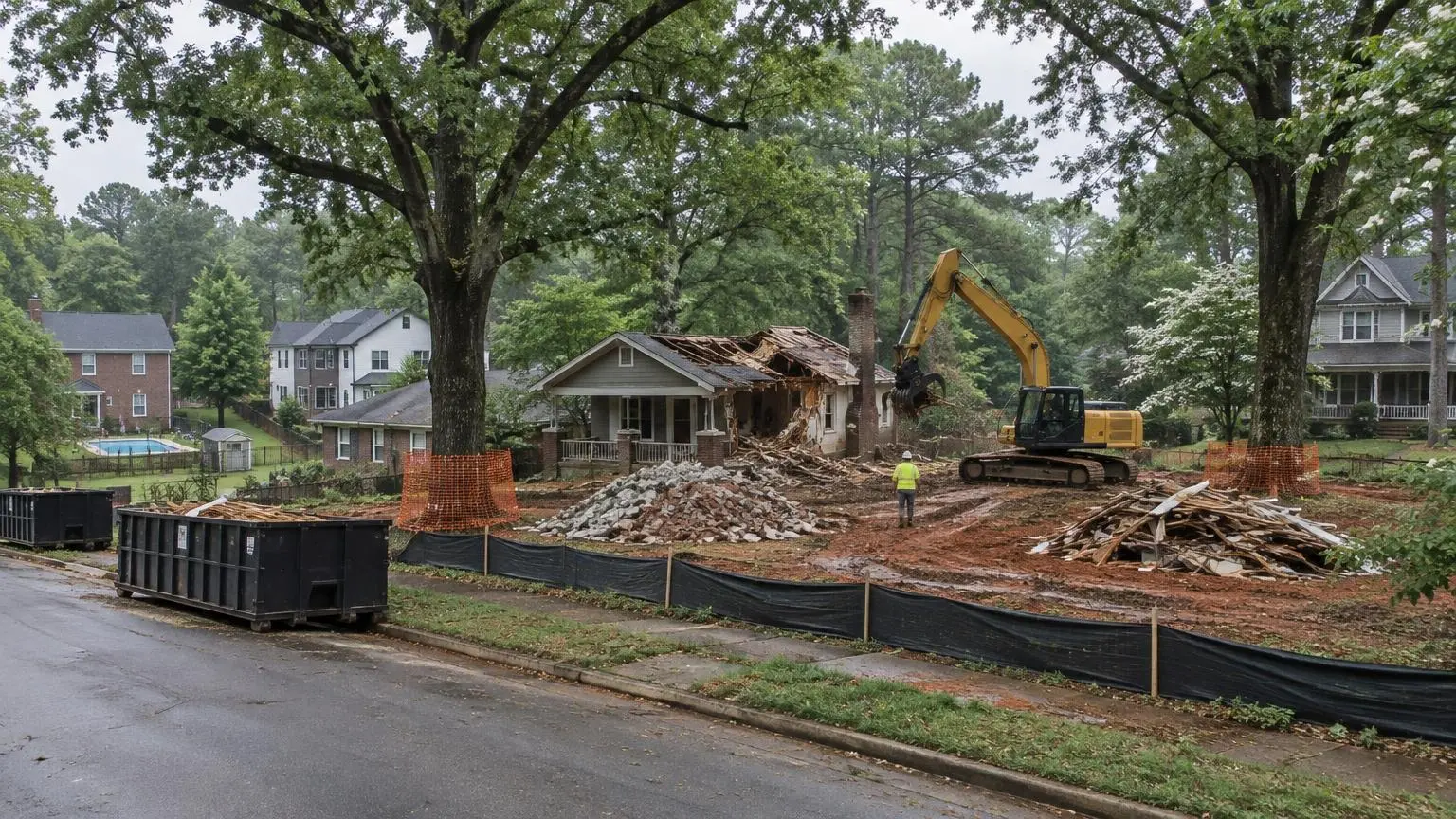
Teardowns, strip-outs and site clearing
Demolition Contractors in Atlanta, GA
Houses, interiors, pools, slabs and outbuildings taken down safely, with permits, utilities and trees sorted out first.
- Free walk-through and a written, itemized estimate
- Permit, utility and tree steps mapped out before any machine arrives
- Debris sorted, hauled and the lot left rough-graded
Clearing Ground in the City in a Forest
Atlanta Demolition Contractors tears down houses, guts interiors and removes pools, concrete, garages and sheds across Atlanta, Georgia. The city has 498,715 residents and 242 officially defined neighborhoods, according to Wikipedia, and it sits mostly in Fulton County with a slice in DeKalb. It is also known as the City in a Forest, with the densest urban tree cover of any major U.S. city. For demolition contractors in Atlanta, that canopy, the clay hills and a detailed city permit process shape almost every job before the first wall comes down.
What Atlanta asks for before a teardown
The City of Atlanta's Demolition Permit Procedures sheet lists the core pieces of a residential demolition permit:
- A rodent letter. A current letter on an exterminating company's letterhead confirming the property was treated.
- A sewer plug. A plumbing permit to cap the sewer line so debris and rodents do not end up in the public system.
- Site plans with erosion control. Twelve copies, routed to Zoning, Site Development, Plan Review, the Office of Planning and the Arborist. The plans show the trees, buildings, roads and driveways on the lot.
- Asbestos paperwork when it applies. If asbestos is being removed, the city will not issue the permit until it sees the notification filed with the Georgia EPD.
The same sheet warns that tearing down a structure with no plan to build a replacement adds more steps before the permit is considered. A newer Office of Buildings policy notice says that when an owner wants a structure declared unsafe or uninhabitable, a Georgia-licensed structural or civil engineer now has to write and sign that assessment and it goes in with the demolition application.
Trees come first in Atlanta
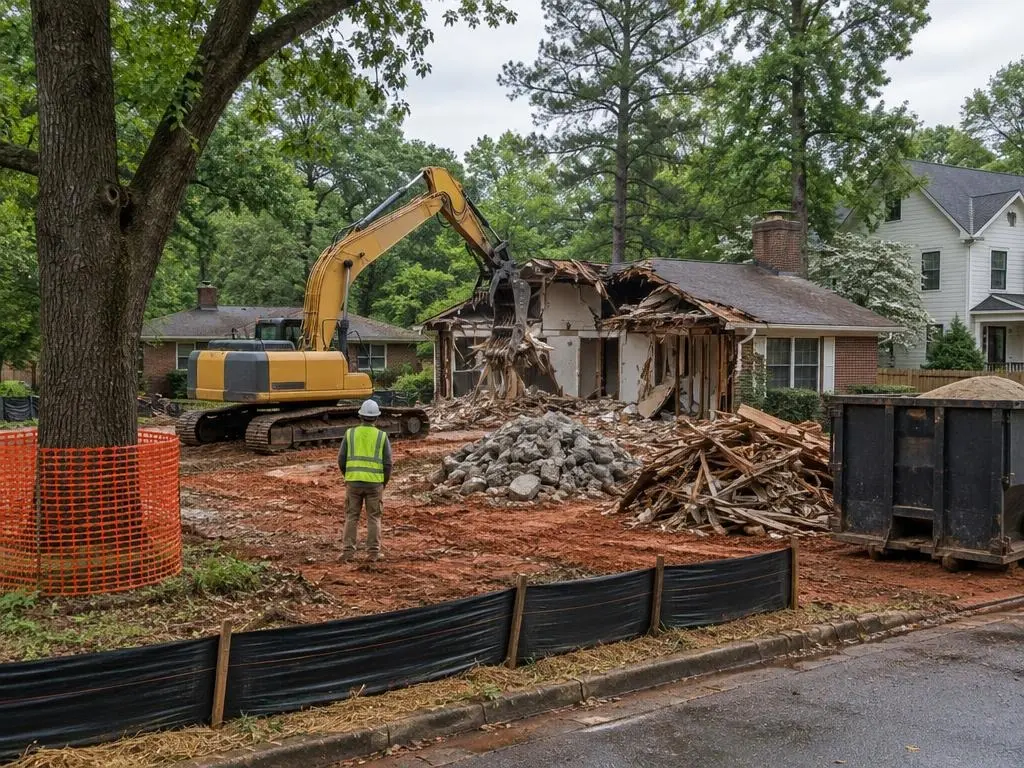
The city's policy is no net loss of trees. Per the Arborist Division's FAQ, any tree 6 inches or more in diameter at breast height needs a permit to remove, and trees affected by construction are permitted through the building permit after arborist plan review. The City Council adopted an updated Tree Protection Ordinance on June 16, 2025, effective January 1, 2026, which raised the recompense charge to $140 per diameter inch, according to Atlanta News First. On a demolition that means protective fencing, staying out of root zones with heavy equipment and planning the truck route around the trees you are keeping.
The houses we take down
Point2Homes, drawing on Census data, puts the median build year of Atlanta housing at 1989, but the spread is wide. About 11.9 percent of homes were built in 1939 or earlier, and roughly 43 percent before 1980. Wikipedia describes craftsman bungalows as the dominant single-family house in the low- and medium-density neighborhoods, and historic streetcar suburbs on the east side built from the 1890s to the 1930s, including Inman Park.
Older houses bring specific demolition issues. Pre-1978 paint may contain lead, and the EPA's Renovation, Repair and Painting rule requires certified firms for paid work that disturbs it. Old floor tile, pipe wrap, siding and roofing can contain asbestos. Many intown bungalows sit on brick piers over a crawlspace rather than a slab, which changes how the foundation comes out and how much fill the hole needs. Houses in designated historic districts are sent to the Urban Design Commission for a Certificate of Appropriateness before the city issues a demolition permit.
Six kinds of demolition
- House demolition: full teardowns of houses and duplexes, including foundations, driveways and walks, with the lot left rough-graded.
- Interior demolition: kitchens, baths, basements and whole-house guts, with load-bearing walls left alone unless an engineer and permit say otherwise.
- Concrete removal: driveways, patios, walks, slabs, steps and footings broken out and hauled, plain or reinforced.
- Pool removal: inground pools partially or fully removed, then backfilled and compacted; aboveground pools taken apart.
- Garage and shed removal: detached garages, carports, sheds, barns and other outbuildings, with or without the slab.
- Commercial demolition: small commercial buildings and interior strip-outs for tenant improvements.
Rain, clay and erosion control
Wikipedia lists Atlanta's average annual precipitation at 50.43 inches, spread over about 116 days. Once a house and its landscaping are gone, bare red clay washes into the street and storm drains fast. That is why the city wants erosion control on the demolition site plan. We install silt fence and a stone construction entrance where the plan calls for them, keep mud off the road, and leave the lot graded so water moves away from neighbors instead of pooling. Summer heat, with highs of 90 degrees or more on about 47 days a year, is also why we start early on long demo days.
From the first call to a cleared lot
Walk-through. We look at the structure, the trees, the access and the neighbors, and talk through what happens after demolition.
Written estimate. Demolition, hauling, foundation removal, fill and grading priced line by line, with testing listed separately if it is needed.
Permits and disconnects. Rodent treatment, sewer plug, site plan, tree protection and asbestos steps lined up. Gas, power and water are disconnected by the utilities before work starts, and Georgia 811, which is free, marks underground lines at least two business days ahead of digging.
Demolition day. Salvage pulled if wanted, the structure taken down, metals and concrete separated from mixed debris, and everything hauled.
Finish. Foundation and slab out, holes backfilled and compacted, lot rough-graded and ready for the next step. Call (470) 260-8440 to set up a walk-through.
Where We Work
Most of our jobs are inside the City of Atlanta, from intown bungalow streets on the east side to neighborhoods on the south and west sides where older houses are being cleared for new building. We also work in the larger cities around it: Sandy Springs, Roswell, Johns Creek and Alpharetta to the north, Marietta and Smyrna to the northwest, Dunwoody and Brookhaven to the northeast, Decatur to the east and East Point to the south. Each of those cities runs its own permit office and tree rules, and parts of the metro are unincorporated county, so we confirm what your address needs before we price the work. Each town page covers what we found about local housing and the rules that apply there.
- Demolition Contractors in Atlanta, GA
- Demolition Contractors in Sandy Springs, GA
- Demolition Contractors in Roswell, GA
- Demolition Contractors in Johns Creek, GA
- Demolition Contractors in Alpharetta, GA
- Demolition Contractors in Marietta, GA
- Demolition Contractors in Smyrna, GA
- Demolition Contractors in Dunwoody, GA
- Demolition Contractors in Brookhaven, GA
- Demolition Contractors in Decatur, GA
- Demolition Contractors in East Point, GA
- Demolition Contractors in Peachtree Corners, GA
- Demolition Contractors in Kennesaw, GA
- Demolition Contractors in Tucker, GA
- Demolition Contractors in Duluth, GA
- Demolition Contractors in Lawrenceville, GA
- Demolition Contractors in College Park, GA
- Demolition Contractors in Chamblee, GA
- Demolition Contractors in Norcross, GA
- Demolition Contractors in Mableton, GA
- Demolition Contractors in Doraville, GA
- Demolition Contractors in Stockbridge, GA
- Demolition Contractors in Snellville, GA
- Demolition Contractors in Lilburn, GA
Common Questions
What should I look for in residential demolition contractors in Atlanta?
Ask each bidder to put the scope in writing: what comes down, whether the foundation and driveway go, what fill and grading are included, and who handles the permit, rodent letter, sewer plug and tree protection. Ask how they handle asbestos and lead paint on an older house. A clear, itemized estimate is easier to compare than a single number.
Do small demolition contractors in Atlanta handle sheds, pools and slabs?
Yes. Smaller jobs like a shed, a detached garage, a backyard pool or a cracked driveway are a big share of our work. They use smaller equipment and fewer truckloads, and many do not need the full set of teardown paperwork, though we still check what your city or county requires.
Do I need a permit to demolish a house in Atlanta?
Yes. The City of Atlanta requires a demolition permit, and its procedures sheet calls for a rodent letter, a plumbing permit to plug the sewer, and site plans with erosion control reviewed by several departments including the arborist. Suburban cities and unincorporated areas have their own versions, so we check the rules for your address.
Who shuts off the utilities before demolition?
Gas, electric and water service have to be disconnected by the providers before a building comes down, and the sewer is plugged under a plumbing permit in the City of Atlanta. We give you the list and the order, and we request Georgia 811 locates before digging out foundations or driveways.
Does my house need an asbestos survey before demolition?
It is wise on any older house, and it is often required. Georgia EPD says homes with four or fewer units are exempt from its demolition notification rule unless part of a larger project, but if asbestos is being removed, the City of Atlanta will not issue the permit until it sees the EPD notification. A survey up front tells you whether abatement belongs in the budget.
How much does it cost to tear down a house?
HomeAdvisor's national guide puts house demolition at $4 to $17 a square foot, with most jobs between $6,000 and $25,000. Fixr lists $7,500 to $15,000 for a 1,500-square-foot house with a slab. Basements, asbestos, tight access and tree protection push the number up. The written estimate after our walk-through is your price.
Can I tear down a house in an Atlanta historic district?
Not without extra review. A City of Atlanta information sheet on historic districts says owners in designated districts who seek a demolition permit are sent to the Urban Design Commission for a Certificate of Appropriateness. Expect that review to add time, and check with the neighborhood association early.
What happens to the trees on my lot?
Atlanta protects trees 6 inches and larger in diameter, and removing one needs a permit and usually a recompense payment. Trees you are keeping get protective fencing, and we keep heavy equipment and debris piles out of their root zones.
Our Demolition Services
Whole-house teardowns, interior strip-outs, concrete, pools, outbuildings and small commercial jobs across metro Atlanta.
House Demolition
Full teardowns of houses and duplexes, foundations included, with permits, utility disconnects, tree protection and haul-off planned up front.
Learn more →Interior Demolition
Kitchens, baths, basements and whole-house guts taken down to the studs, with dust control and load-bearing walls left to the engineer.
Learn more →Concrete Removal
Driveways, patios, walks, slabs, steps and footings broken out and hauled, plain or reinforced, with the ground left ready for what comes next.
Learn more →Pool Removal
Inground pools partially or fully removed, backfilled and compacted; aboveground pools taken down and hauled away.
Learn more →Garage & Shed Removal
Detached garages, carports, sheds, barns and other outbuildings taken down and hauled, with or without the slab.
Learn more →Commercial Demolition
Small commercial buildings and tenant strip-outs, with asbestos surveys, EPD notification and city permits handled on schedule.
Learn more →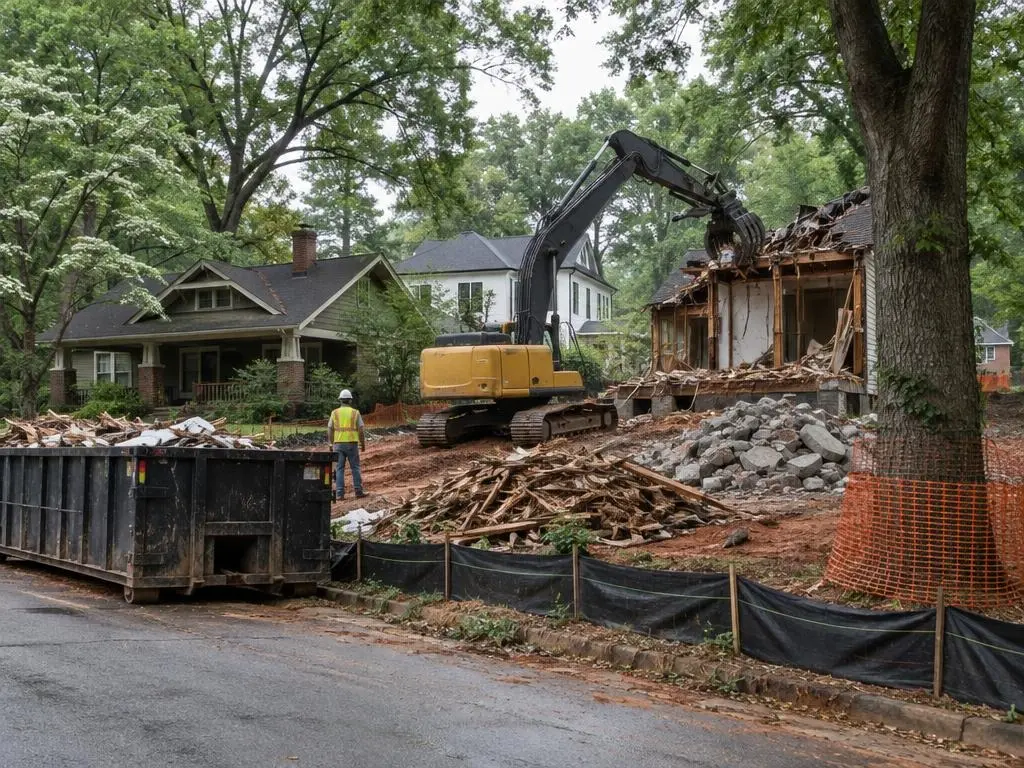
Why Homeowners Call Atlanta Demolition Contractors
Permits mapped early
Rodent letter, sewer plug, erosion-control site plan and arborist review laid out before we schedule a crew.
Trees protected
Fencing and equipment routes planned around the trees that stay, in a city with a no-net-loss tree policy.
Testing before tearing
Asbestos survey arranged when a building may contain it, so there are no surprises mid-job.
Itemized pricing
Labor, hauling, foundation removal, fill and grading each priced on their own line.
Get a Demolition Estimate in Atlanta
Free walk-through and a written, itemized price for teardowns and removals in Atlanta and the surrounding metro.